

Settings → Skills & Routing section. Here they can be organized hierarchically to ensure structured classification.
Types of Tags
Tags are the basis for ticket categorization. They allow tickets to be classified according to different criteria. The following tags are distinguished: Skill TagsThese tags represent specific skills or fields of expertise such as Billing or Change. If they are stored with a staff member, tickets with these skill tags are automatically routed to the appropriate agents or teams. General Tags
In addition to the skill tags that relate to the skills of employees, other tag categories are available. These tags allow for flexible structuring, labeling, and for use in automatic distribution:
General Tags
General Tags
Brand Tags
Brand Tags
Product Tags
Product Tags
Customer Tags
Customer Tags
Contract Tags
Contract Tags
Automatic Tag Assignment
We offer various detection methods to assign certain tags to incoming tickets. The configuration of these assignment rules is performed per tag. The following methods are available:AI Detection
AI Detection
We utilize machine learning algorithms to automatically assign tags based on patterns and historical data. The AI learns autonomously and is further trained by manual changes made by the employee.ExampleTraining data for customer concerns about “Bank details”:
Condition Detection
Condition Detection
Tags are assigned based on ticket, customer, and/or contract attributes. Conditions can be linked arbitrarily.Operators and expected values
ExampleLinking of conditions for customer concerns for marketing purposes: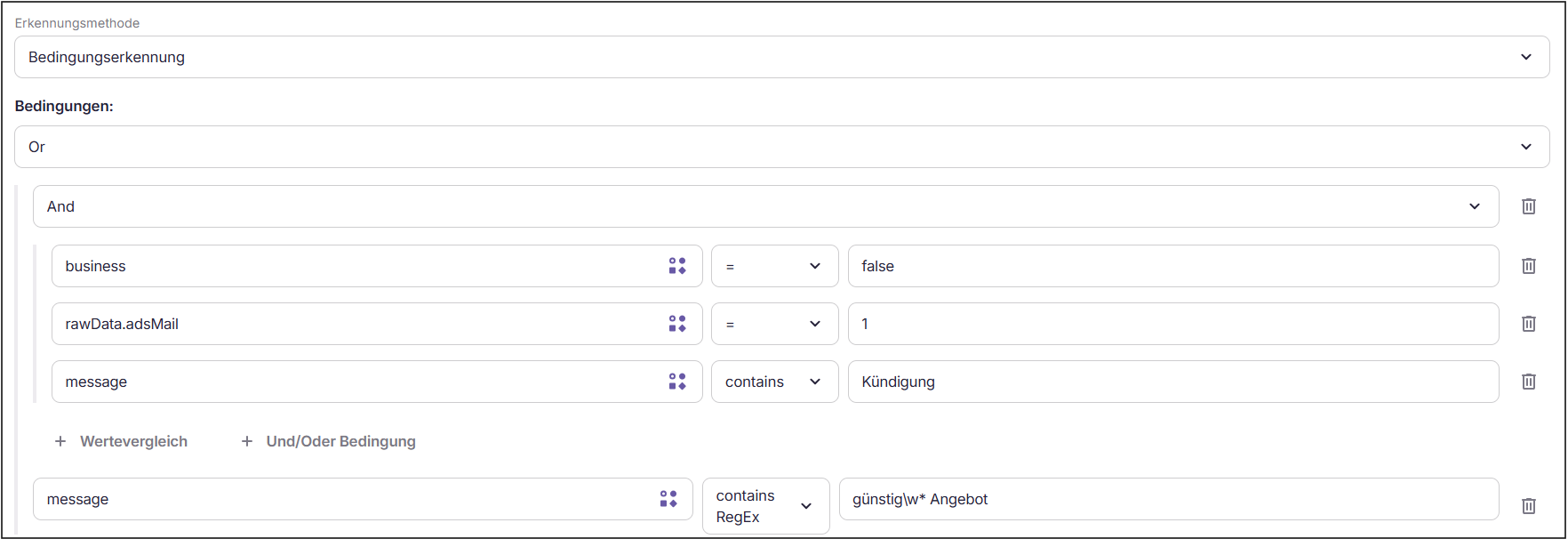
| Operator | Expected data type | Effect |
|---|---|---|
= | string, number, or boolean | Checks whether the data point exactly matches the specified value. |
!= | string, number, or boolean | Checks whether the data point deviates from the specified value. |
contains | string | Checks whether the data point contains the specified text. |
not contains | string | Checks whether the data point does not contain the specified text. |
in | array | Checks whether the data point is contained in the specified list of values. |
not in | array | Checks whether the data point is not contained in the specified list of values. |
> / >= / < / <= | number | Compares the data point numerically with the specified value. |
is null | null or no value | Checks whether no value is present. |
is not null | null or no value | Checks whether a value is present. |
contains RegEx | string | Checks whether the data point matches a regular expression. |
AI and Condition Detection
AI and Condition Detection
Tags are assigned when both methods apply.ExampleHere tags are recognized when the AI training data applies, AND the customer’s message does not refer to cancellation or relocation: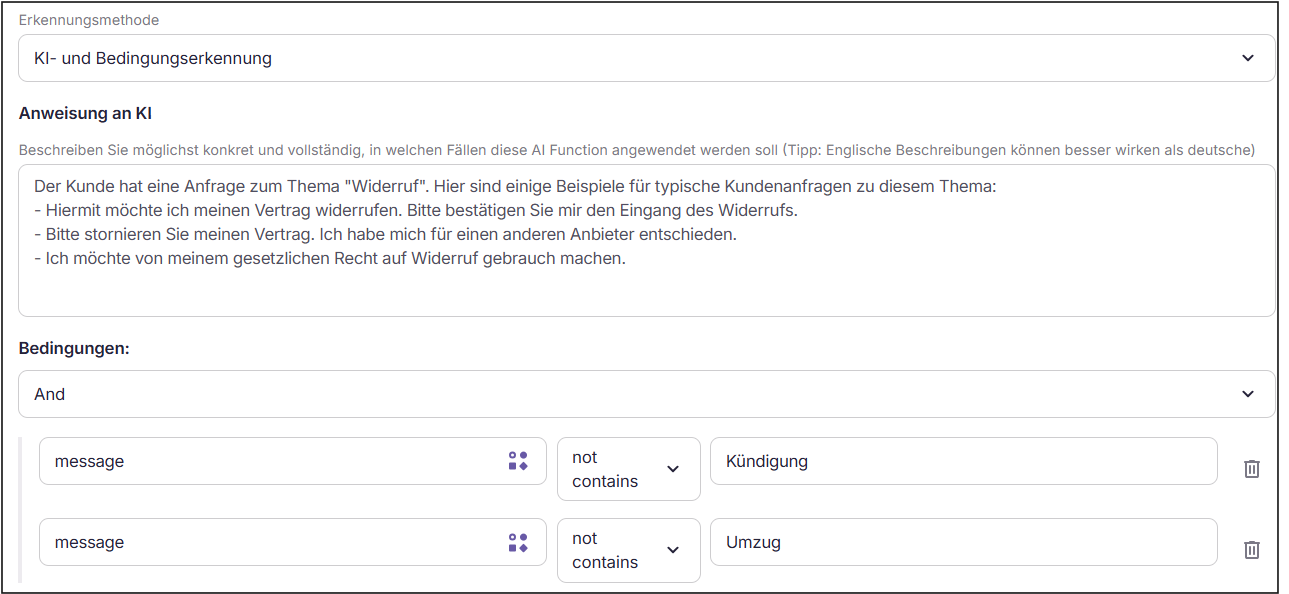
AI or Condition Detection
AI or Condition Detection
Tags are assigned based on one of the two methods.ExampleHere tags are recognized when the AI training data applies, OR the customer’s message does not refer to cancellation or relocation. This assignment would probably apply for many cases: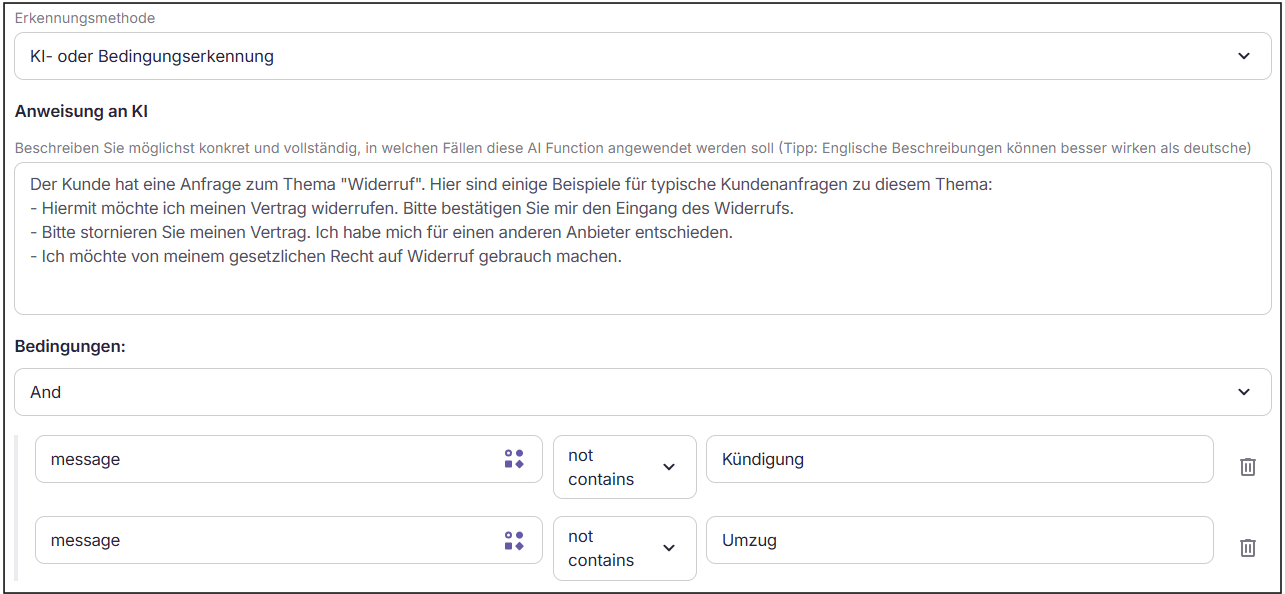
Channel
Channel
Tags are assigned based on the entry channel of the ticket. If, for example, “Portal” and “Email” are set as the channel, the tag is recognized only for these two channels. Tickets with entry channel “Letter” are excluded from assignment here.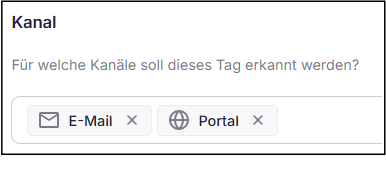
Subchannel
Subchannel
Analogous to “Channel”, tags are assigned based on the subchannel through which a ticket was received. Subchannels can be special email mailboxes, chatbots, or telephone lines.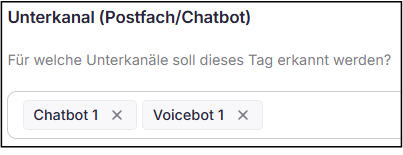
Manual Detection Only
Manual Detection Only
Tags are exclusively assigned manually by the operator themselves.
Further Configuration Options
Additional settings enable even more precise control:Visibility
Visibility
- Visible / activated: these tags are automatically assigned and can be seen by every employee in the ticket
- Not visible / deactivated: these tags are no longer automatically assigned and are only visible in already tagged tickets
- Private / internal only: these tags are automatically assigned, but are only recognizable by employees with the “View Private Tags” permission
Complexity
Complexity
The complexity determines which tag should be considered definitive for evaluation purposes when multiple tags have been assigned to a ticket. The tag with the highest complexity (“Specialist Topic”) is used as the primary tag.
Priority
Priority
To prioritize tickets with certain tags, it may sometimes be necessary to adjust the routing priority. This enables the ticket processing process to be aligned with individual requirements. The higher the priority, the quicker the ticket will be assigned to an agent for the same deadline and can be processed preferentially.
Routing Relevance
Routing Relevance
Determines whether a tag is considered in the skill-matching logic in routing. If the routing relevance is deactivated, the tag is ignored in agent assignment — agents without this skill can still get tickets with this tag. This is useful for tags that are purely for categorization or internal labeling and are not meant to influence ticket distribution.
Test Cases
Test Cases
To verify whether the configured recognition of a tag is functioning correctly, test cases can be stored. After entering a ticket ID, the “Playback” button is pressed. The result of the test is displayed immediately below.